

The PT100 3-wire RTD (Resistance Temperature Detector) is the most common industrial temperature sensor. It is prized for its excellent stability, repeatability, and accuracy across a wide temperature range, typically from -200°C to +550°C.
1. Understanding the “PT100” Name
-
PT: Stands for Platinum, the material used for the sensing element due to its linear resistance-to-temperature relationship.
-
100: Indicates that the sensor has a nominal resistance of 100 Ohms at 0°C.
2. Why Use 3 Wires?
In a standard 2-wire setup, the resistance of the lead wires themselves is added to the sensor’s reading, causing a “temperature offset” error. The 3-wire configuration solves this:
-
Wire 1 & 2: Connected to one side of the PT100 element.
-
Wire 3: Connected to the other side.
-
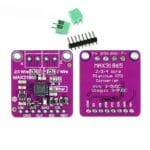
The Benefit: Industrial controllers (like the MAX31865) measure the resistance between the two common wires to calculate the lead resistance and then subtract it from the total measurement. This provides a much more accurate reading than a 2-wire sensor, especially when the probe is far from the controller.

3. Construction Details
A typical PT100 probe consists of several layers to ensure longevity in harsh environments:
-
The Tip: Contains the platinum resistor embedded in ceramic or glass.
-
The Filling: Packed with magnesium oxide (MgO) powder to provide high thermal conductivity and vibration resistance.
-
The Sheath: A protective metal tube.
-
The Transition: The point where the rigid probe meets the flexible lead wires, often reinforced with a spring or potting.
-
Lead Wires: Usually insulated with Teflon (PTFE), Fiberglass, or PVC depending on the environment’s heat.
4. Color Coding (IEC 60751 Standard)
To properly connect a 3-wire PT100, you must identify the “common” wires.
-
White (x1): Connected to one side of the resistor.
-
Red (x2): Both connected to the other side of the resistor.
5. Common Applications
-
HVAC: Monitoring air duct and chilled water temperatures.
-
Food & Beverage: Monitoring pasteurization and storage temperatures.
-
Pharma: Stability chambers and laboratory incubators.
-
Plastics: Monitoring melt temperatures in injection molding machines.